
Long-term care · Memory care · Ontario
Memory care without ankle bracelets.
A secure unit has one way to keep a resident from walking out the front door. Lock it, alarm it, and hope somebody hears. The lock cannot tell a resident from a visitor. The alarm stopped meaning anything weeks ago.
GateKeypers builds a door that recognises the person in front of it. No band. No fob. No badge. No phone. No camera in any room a resident lives in.
In development for memory care. Seeking our first pilot home.
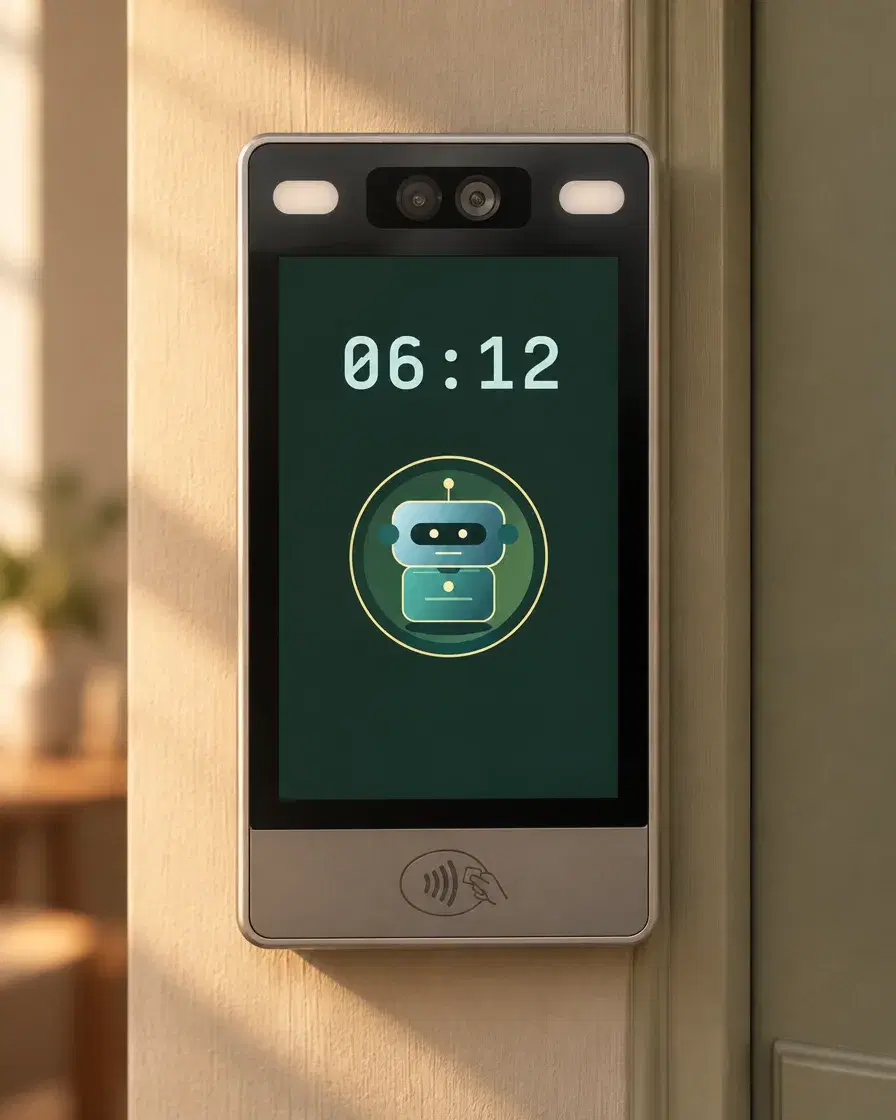
Interactive illustration of the intended workflow. Presence sensing is on a bench, not in a home. The Where We Are section says what is real today.
The threshold, a little before six. Nothing to wear. Nothing to carry.
Concept film. The device shown is a rendering, not the shipping hardware.
The hour nobody plans for
The hardest hour is not the one you would guess.
Ask the people who work a secure unit overnight when it gets hard and they will not say three in the morning. They will say six, because six is when care starts and everybody is already in a room with somebody.
Most of what goes off in that hour is real. Somebody genuinely needs a person. The door should not be one more thing going off. It should know who is standing at it, open for the people who belong, stay closed for the resident who shouldn’t be out alone, and write the record. Nothing sounds. Nobody gets pulled out of a room.
Ontario’s Long-Term Care Home Design Manual requires locks on those doors, magnetic locks on exterior and stairwell doors, and a back-up alarm if the magnetic locks fail. It contains no provision for a door that knows who is standing at it.
Retirement residences with a memory care floor lock the same doors.
Source. Ontario Ministry of Long-Term Care, Long-Term Care Home Design Manual, sections 8.2.1, 8.2.3 and 8.2.4. Read the sections we rely on
What the Keyper does
The door knows who belongs.
One device at the threshold. It recognises, and it opens. Nothing on the resident and nothing in the room.
01
It recognises without asking
Presence sensing at the threshold. Nothing to wear and nothing to carry, and no camera in a room a resident lives in, because a camera will not get consent in a memory-care unit and should not.
02
It narrows who gets stopped
A locked unit applies prevention to every resident, continuously, undifferentiated and unrecorded. A door that recognises people applies it where a documented duty says it applies.
03
It writes a record an inspector can read
Who opened the door, when, and how long they were there. As it happens, in one place, in a form built for an inspection rather than for a billing cycle.
A face to the technology
A door with manners.
Three people come to a secure-unit door. The Keyper answers each one differently, and none of them has to wear, carry or type anything.
Who is at the door?
The Keyper is the character on the door’s screen. The reactions are the ones the terminal shows today; the memory-care behaviour behind them is in build. See Where We Are.
What is real todaySomeone is coming.
Choose who arrives and watch how the door answers.
Install
We need power and a network. That is the whole install.
A traditional access installation runs conduit, junction boxes, panel wiring and licensed integrator time before a single door works. We need an outlet and a network connection. One technician, under two hours a door, no construction, and the credentials the building already carries keep working.
Hardware is included and priced per resident bed or suite, per wing, on your operating line. There is no capital request waiting for the next budget cycle.
Where we are, in full
What is real today, and what is not.
We are a pre-pilot company and this page will tell you where the line is, because you will find out anyway and we would rather you found out from us.
- Shipping and paid
- A regulated deployment securing biospecimen storage, on a monthly subscription.
- In build
- Presence, occupancy count and unattended floor-level events at the door. On a bench, with a known failure mode we will describe before anyone asks.
- Not built
- Vitals. How someone walks. Anything a person would call clinical. This page will say so the day that changes and not before.
- In progress
- SOC 2 Type I.
- Zero
- Long-term care homes running this in production. We are looking for the first one.

Why this exists
“It knew a door code. It knew a keycard. It didn’t know her.”
My grandmother raised me. She got lost inside a building that was supposed to keep her safe.
Care in these homes is good. The people doing it are working at the edge of what the building gives them. The occasional failure is the kind better information could prevent, and that is the only thing we are trying to build.
Vino Kandasamy, founder. The team is seven people. The engineering bench is one full-time hardware engineer and one part-time platform lead, which is the thinnest thing about us.
The ask
We are looking for one home.
A ninety day paid pilot on one secured unit. You get the data on your own residents and a record you can hand an inspector. We get the first honest account anybody in this category has published of what a door on a secured unit handled on its own over ninety days, and what it didn’t.
If that is worth a conversation, reply to whoever sent you here, or reach the team directly.